

Staff Correspondent
A proposal has been sent to the prime minister for her approval, says the state minister for public administration
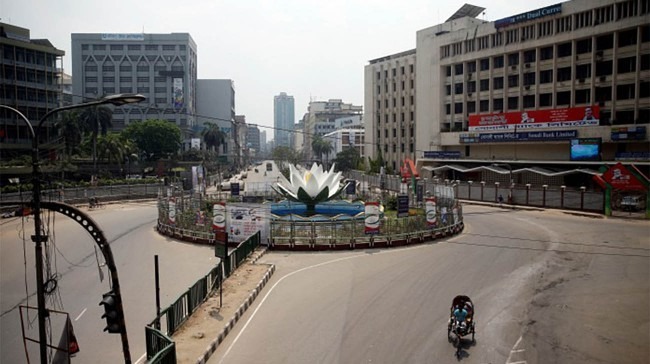
The government has decided to extend the ongoing restrictions on movement by another week.
The decision came from a meeting of secretaries chaired by Cabinet Secretary Khandker Anwarul Islam in Dhaka on Monday.
“It has been decided to extend the ongoing lockdown from April 22 to 28. A proposal has been sent to the prime minister for her approval, following which a gazette notification will be issued,” said State Minister for Public Administration Farhad Hossain.
The move comes in line with the recommendation of the national advisory panel, he said, before adding that it would “break the current chain of infection transmission.”
At a meeting on Sunday, the Covid-19 National Technical Advisory Committee (NTAC) recommended extending the lockdown by a week to stem the spread of the deadly virus in the country.
Amid the resurgence in infections and deaths, the NTAC had recommended a complete lockdown for at least two weeks. The government has already implemented a weeklong lockdown from April 14.
It suggested reviewing the infection rate before ending the lockdown. A plan should be designed to lift the lockdown gradually, the panel said in a statement sent to the media on Monday.
Present rules to remain in force
Talking to newsmen, Press Information Department (PID) Principal Information Officer Surath Kumar Sarker said ongoing rules on movement restrictions will remain in force during the fresh lockdown to be imposed from April 22 till April 28. The lockdown, which started on April 14, will end at 12 midnight on April 21. The 7-day lockdown will start again from 6am on April 22.
NTAC recommendations
Following a virtual meeting on Sunday night, NTAC has recommended another week of strict lockdown to control the spread of the deadly virus in the country.
Previously, NTAC recommended a full lockdown for at least two weeks. The government has already implemented a weeklong lockdown from April 14 and the committee expressed satisfaction over that.
However, scientifically effective results cannot be expected in less than two weeks of lockdown.
The committee realized the need to keep the industries open in the interest of keeping the country’s economy afloat. However, private offices, banks being kept open, increasing private car traffic, unwanted and unnecessary extra crowds in the Iftar markets make the success of the lockdown uncertain.
NTAC advised keeping everything closed except for health, fire service, and other emergency services.
Restrictions as per previous notification
All modes of public transports, including those of roads, riverways, railways, and air, will remain suspended during the lockdown.
However, the offices related to air, maritime and river and land ports will remain out of the preview of the lockdown.
However, the restriction will not be effective in the case of carrying goods, emergency services, and production.
The offices, staffers and vehicles of the organisations providing emergency services, including law enforcement, agricultural products (fertilizer, seeds, pesticides, machineries), crops, food-laden vehicles, relief distribution, health services, health workers involved in mass inoculation, power, water, gas, fire services, port activities, media (print and electronic media), private security management, telephone, and postal services will remain out of the purview of the restriction.
Industries and factories
Industries and factories will remain open on condition of maintaining health protocols. The respective factories or industries must take measures to carry their employees in their own vehicles.
Public movement
Public movement will be restricted and no one will be allowed to go outside except for certain emergency needs (to purchase medicines, daily essentials, to take medical services and burial/ cremation of dead bodies, taking Covid-19 jabs etc).
Hotels and restaurants
Hotels and restaurants can operate from 12 noon to 7 pm and 12 midnight to 6 am with takeaway/online services only.
Markets and shops
All the shopping malls and markets will remain closed during this period.
Daily essential items like kitchen items can be sold and purchased from open spaces from 9 am to 3 pm complying with health protocols. Local administrations and the authorities concerned will ensure it.
The local administration concerned will take steps in a coordinated way for carrying agricultural workers for harvesting Boro paddy.
District and field administrations will take measures to enforce the directives in a coordinated way. Law enforcement agencies will strengthen patrol and take legal action against those who will violate the directives.
The director general of the Directorate General of Health Services will take necessary steps to engage law enforcers and local administration on behalf of him.
Worsening Covid situation
Bangladesh saw its daily deaths from coronavirus shatter the local records yet again with 102 fatalities between Saturday and Sunday morning.
It was the third consecutive day that the country registered more than 100 deaths in 24 hours.
The latest fatalities pushed up the death tally to 10,385 with a mortality rate of 1.44 percent, according to a handout from the Directorate General of Health Services.
Data released by the government show a downward trend in tests and new cases as the number of deaths and recoveries rise steadily.
Bangladesh reported its first coronavirus cases on March 8, 2020, and the first death on March 18 that year.
The country has so far confirmed 718,950 cases. Of those, 614,936 people – 85.53% of all patients – have recovered so far.
Bangladesh inked an agreement with the Serum Institute of India Pvt Ltd for 30 million doses of the AstraZeneca vaccine.
A countrywide inoculation drive was launched on Feb 7. Until Sunday morning, 7,116,946 have registered for the vaccine.
So far, 57,14,090 people have received the first dose and 13,66,609 have got their second jab, according to official figures.


