

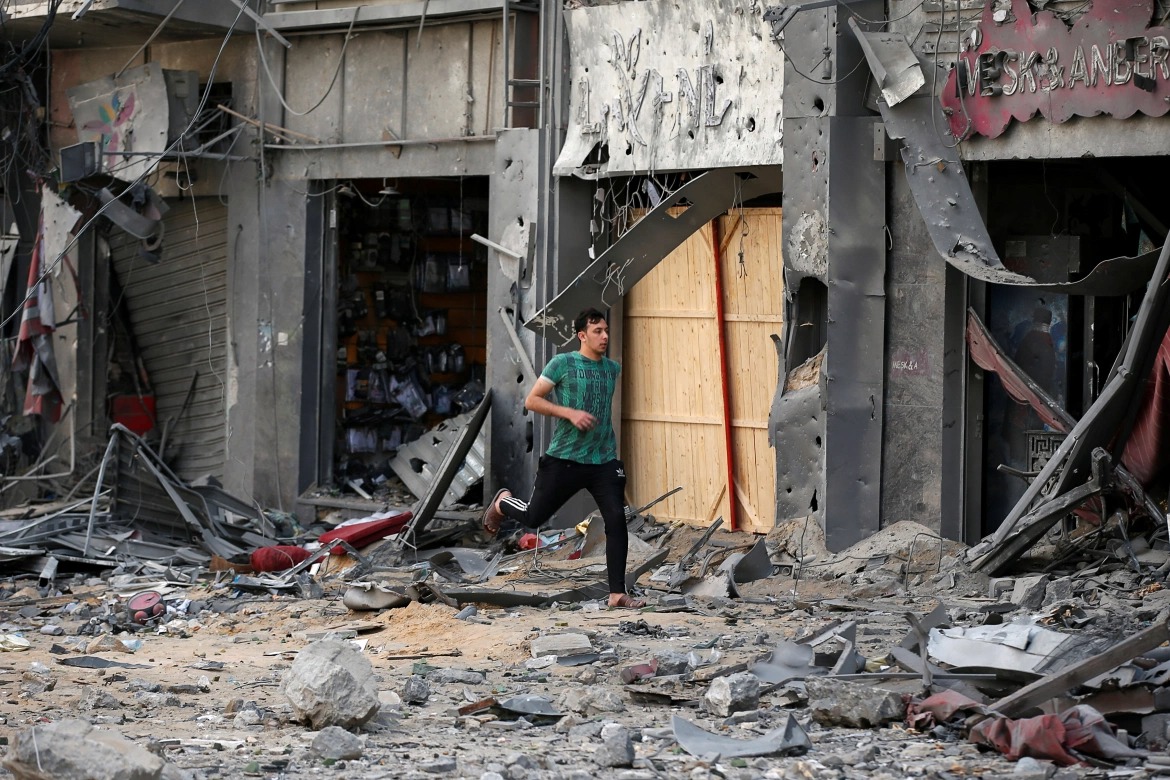
International pressure to bring an end to the raging conflict between Israel and Hamas militants mounted on Sunday, even as local health officials said an Israeli airstrike in Gaza overnight killed at least 42 people. The dead included women and children, the Gaza Health Ministry said in a statement to The Associated Press (AP).
On Sunday morning, rescue workers combed through the rubble of three buildings flattened in the Israeli airstrike as the hostilities between Israelis and Palestinians escalated to levels not seen since a 2014 war.
With the conflict stretching into its seventh straight day, the United States stepped up its diplomatic engagement and the United Nations Security Council was scheduled to meet to discuss the conflict for the first time on Sunday. Prime Minister Benjamin Netanyahu of Israel vowed late Saturday to continue striking Gaza “until we reach our targets,” suggesting a prolonged assault on the coastal territory even as casualties rose on both sides.
In separate calls on Saturday, President Biden conferred with Mr. Netanyahu and Mahmoud Abbas, president of the Palestinian Authority, about efforts to broker a cease-fire. While supporting Israel’s right to defend itself from rocket attacks by Hamas militants, Mr. Biden urged Mr. Netanyahu to protect civilians and journalists.
Even before Sunday morning’s attack, Israeli airstrikes had intensified over the weekend, with an attack on a house in a refugee camp in Gaza that killed 10 members of an extended family, including women and children, and another that destroyed a high-rise that housed media outlets including The A.P. and Al Jazeera.
Israeli defense officials said the building housed military assets belonging to Hamas and they provided advance warning to civilians in the building to allow evacuation. No casualties were reported in that strike.
More than 170 Palestinians had been killed in Israeli airstrikes and shelling in Gaza, and 12 Israelis had died in Hamas rocket attacks. Over the past week, the 15-member U.N. Security Council met privately at least twice to discuss ways of reducing tensions. But efforts to reach agreement on a statement or to hold an open meeting had faced resistance from the United States, Israel’s biggest defender on the council.
American officials said they wanted to give mediators sent to the region from the United States, Egypt and Qatar an opportunity to defuse the crisis.
But with violence worsening, a compromise was reached for a meeting on Sunday at 10 a.m. Eastern time, to be held via videoconference because of pandemic restrictions, and streamed live on a U.N. website.
The American ambassador, Linda Thomas-Greenfield, said in a statement posted on Twitter after the meeting was announced that “the U.S. will continue to actively engage in diplomacy at the highest levels to try to de-escalate tensions.”
Security Council meetings on the Israeli-Palestinian issue have often ended inconclusively and served mainly as a platform for supporters of both sides to air their grievances. But they have also demonstrated the widespread view among United Nations members that Israel’s actions as an occupying power are illegal and that its use of deadly force is disproportionately harsh.
Israel shared intelligence with the US showing how Hamas operated inside the same building with the Associated Press and Al-Jazeera in Gaza, officials in Jerusalem said on Sunday.
Officials in more than one government office confirmed that US President Joe Biden’s phone call to Prime Minister Benjamin Netanyahu on Saturday was, in part, about the bombing of the building, and that Israel showed Biden and American officials the intelligence behind the action.
“We showed them the smoking gun proving Hamas worked out of that building,” a source close to Foreign Minister Gabi Ashkenazi said. “I understand they found the explanation satisfactory.”
Another senior Israeli official admitted that the fact that the bombing took place two days after a tweet by the IDF misled some foreign media into reporting that ground troops had entered Gaza made the situation more difficult from a public diplomacy perspective.
“From an analysis the Foreign Ministry did on Sunday, 80% of the 90 countries we spoke to in recent days released official statements supporting Israel’s right to defend itself. They aren’t calling to stop the operation,” the ministry source said.
Ashkenazi also spoke to over 30 foreign ministers around the world.
“We’re still in a positive place when it comes to our legitimacy to act,” the Foreign Ministry source added. “There is very clear support for the Israeli stance that the terrorism crossed a line” the Israeli Foreign Ministry stated.


