

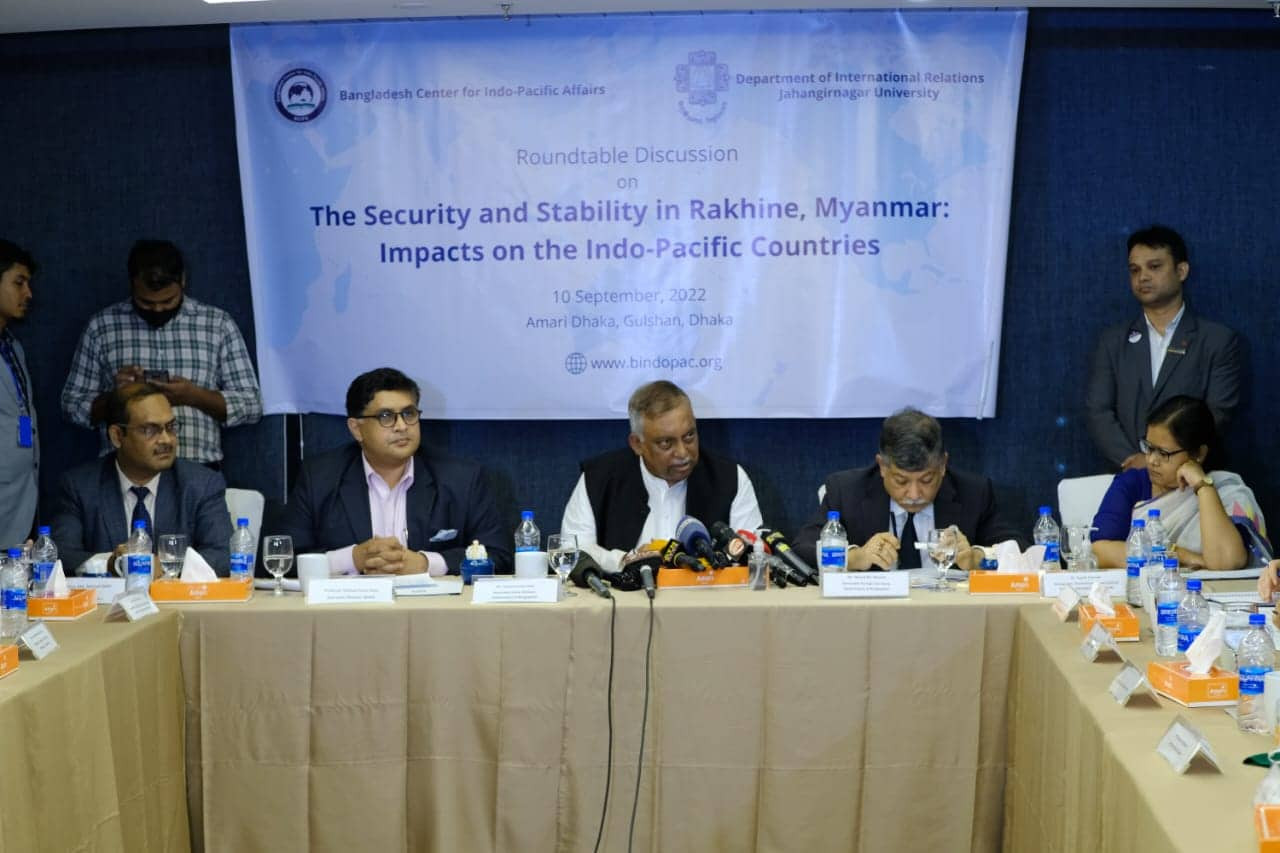
A bolder role from the international community is imperative to help facilitate the safe and fast repatriation of the Rohingyas sheltered in Bangladesh, experts and stakeholders told a discussion on Saturday.
The international community must speak out about the importance of ethnic diversity and religious tolerance in Myanmar, they added.
Bangladesh officials said they were carefully observing the border violation by Myanmar and warned it of taking serious action if the situation worsens.
The Bangladesh Center for Indo-Pacific Affairs (BCIPA), a thinktank of the Department of International Relations at Jahangirnagar University (JU), organized the discussion, titled “The Security and Stability in Rakhine Myanmar: Impacts on the Indo-Pacific Countries”, at a hotel in Dhaka yesterday.
Shahab Enam Khan, professor of International Relations, JU and the platform’s executive director, moderated the event.
The problems in Rakhine and the problems of the rohingyas are really a subset of a wider problem: the narco economy and ethnic conflicts. The problems have worsened by the coup last year and the crises have been playing out in all sorts of ways including the consequences we’re seeing on the border with Bangladesh right now.
The elements of solution would be to have some form of discussions with the national unity government to at least to get a prototype of the sort of forces we’d have to engage. In order to ensure a process of accountability and a process which would recognize the ethnic minorities including the Rohingyas in Myanmar politics, the wider international community must be engaged.
Haznah Md Hashim, Malaysian High Commissioner
The ongoing insecurity and instability in the Rakhine state has caused a spillover effect across the region. We fear that if the situation there is not properly addressed, militant elements like Islamic State and al-Qaeda can take advantage of this deteriorating situation. All these security issues should be a concern to the international committee as a new base of terror group has the potential to cause death and disruption beyond their origin. To conclude long miseries, we need to do it now, rather than tomorrow.
Nayeem Ashfaque Chowdhury, Myanmar Expert, BCIPA
Rohingya refugees are facing an unprecedented identity crisis. All historical and anthropological evidence shows that they have been denied all human rights. They have never experienced any political liberty. Undoubtedly, the brutal army operations in Myanmar state is a textbook example and a classic case of ethnic cleansing.
Delwar Hossain, Professor of International Relations, Dhaka University
Security and stability in the Rakhine state are under threat and the residents there are facing growing danger. The Myanmar junta has started a war against democracy especially, by jailing Aung San Suu Kyi. It should be noted that they’ve created regional instability in the name of fighting the Rakhine (Arakan) army. Hence, we need to focus on Myanmar not only for democracy but for security issues.
Richard Horsey, Senior Advisor, Myanmar International Crisis Group
The situation in Rakhine has become a globalized issue, especially after the military coup. The Arakan Army needs to fight for their dream keeping in mind that repatriation is a distant dream. Also, the world community needs to continue to support Bangladesh.
Mohammad Mozahidul Islam, Professor of History, JahangirnagarUniversity
The crisis in Myanmar is escalating and it has become a global crisis. No nation can trust the Myanmar regime now. The instability in Rakhine is like a volcano now and it is now the sign of a full-blown war creating further tension in India and China. Moreover, the isolated Myanmar junta will depend more on China, with the situation triggering a serious challenge for Indo-Pacific nations.
Andreas Indregard, Regional Representative, NOREF
Violent clashes in the Rakhine state are prevalent now and the Arakan Army needs to extend its territory.
Lt Gen (Retd) Sabbir Ahmed, Former Chief of General Staff, Bangladesh Army
Rohingyas have been tortured in their own country and there are many evidence of crimes against humanity. They need to be supported socio-economically and it is an essential point of their sustainable repatriation. As long as they stay in Bangladesh, the government needs to coordinate their activities and territorial integrity needs to be preserved with courage.
Ky Thying Aung, Representative of the Rakhine Community
Losing independence, especially after WWII, the Rakhaine became the main victim to ethnic cleansing. Burmese people have been worshiped as Sun gods and Rakhaines were treated as servants. We have walked through the dead bodies of our ancestors and the identity crisis is still a serious issue. The Rakhine have never been accepted as a dominant enthic group.
Nurul Islam, President, ARNO
The Rohigya crisis is undoubtedly a man-induced problem. It is only creating discrimination and threatening our peace and stability.
Imtiaz Ahmed, Professor of International Relations, Dhaka University
We need to start working on a Rohingya civil entity. Whenever we talk about the Rohingya community, we talk about ARSA. There’s no civil entity. It is high time we have a Rohingya council in exile.
When we talk about tripartite negotiation, we only talk about China. It’s high time we engaged other countries in these negotiations as they maintain diplomatic relations with both Bangladesh and Myanmar.
M Sakhawat Hossain, Former Election Commissioner
Myanmar forces are operating very close to the Bangladesh border and the alarming fact is that they are inviting Rohingyas to join them. The policymakers must look into new factors regarding regional crises and see how we can tackle those.
Masud Bin Momen, Foreign Secretary
The number of crimes has increased in Rohingya camps. Despite numerous constraints, we decided to give shelter to this large number of people. But Myanmar violated our airspace using drones recently and if the situation aggravates, we will take serious action. We’re still working for the safe return of the Rohingyas, for which support from the international community is essential.
Lilly Nicholls, Canadian High Commissioner
We’ve been focusing on supporting life-changing solutions regarding health and education (at the Rohingya camps). At regional level, Canada has been encouraging Asean to go tough against Myanmar. Canada has also imposed the strongest sanctions on Myanmar. The country also spoke against human rights violations by Myanmar, in the global-level including in International Criminal Court and the ICJ.
Arturo Hikes, Representative, US Embassy
Five years after the Rohingya exodus, it is clear that things have gotten worse. Myanmar committed violence against its own people, leaving profound effects on the entire Indo-Pacific region. Efforts to hold Myanmar accountable must continue.
Assaduzzaman Khan, Home Minister
The Rohingya crisis is not only affecting Bangladesh but the global community. Locals in and around the Rohingya camps are suffering most due to the Rohingya crisis.
We signed a Memorandum of Understanding (MoU) with Myanmar regarding the Rohingya repatriation but it is yet to start.
In the meantime, Myanmar forces started shelling along the Bangladesh border, violating international laws.
Ito Naoki, Japanese Ambassador
The most important thing is how we can prevent the situation in Rakhine from developing into a regional crisis. We need to join hands to help improve the situation there alongside for the betterment of Rohingya people. We should not let the Rohingya refugees be the cause of instability and we need to promote the process of their repatriation.
Tasima Persoob, Chairperson, Department of International Relations, JU
The Rohingya issue, which has already turned into a global crisis by now, should be addressed at the earliest.
Shahab Enam Khan, Professor of International Relations, JU
The Roringya crisis is already a global issue now and it is hampering all the Indo-pacific nations. Political will is very important to resolve the crisis.


